Since it was still early-ish, Risu summoned himself a cup of coffee, which he drank in generous gulps, tidying up his desk a little on the side and wondering what the Miner kid was doing. Maybe just stretching his legs.
He was very pleased with his students. Relativity (even if they had only managed to cover special relativity) was a very difficult topic full of subtleties, and the class appeared to have understood them all. That was impressive, relativity being something most people, in Risu's experience, did not even study before becoming undergraduates at universities.
When the clock on his desk ticked close to the full hour, he finished his coffee and put the empty cup down on the desk. There was now some space to do that. Shooing Alex back to his own table, Risu resumed his usual position in front of the class, waiting for the last students to file back in. He waved his hand in the direction of the door, and it closed.
Astronomy double period - Macrocosm, microcosm
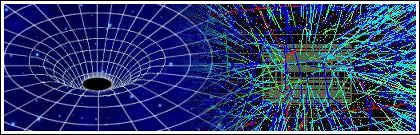
Part two of this double period begins now, lesson 3 overall.
"Welcome back, everyone. I know you probably don't feel like doing another lesson, but I promise we will go easier in this one." He smiled. "As I said in the beginning, the topic will be quantum theory, more commonly known as quantum mechanics. It's a strange theory, even more so than relativity, so we will only discuss a few basic concepts, but they should be enough to give you an idea.
"Quantum mechanics," Risu continued, "is the second triumph of 20th century physics, next to relativity. It is an astonishingly successful theory, describing every single interaction in the Universe with the exception of gravity. Its equations are so accurate that, if you used quantum theory to calculate distances, you could pin down the distance between New York City and Los Angeles to within the width of a human hair.
"Quantum mechanics was developed in the early decades of the 20th century, almost parallel to relativity. It was a completely new branch of physics - it introduced the notion of
uncertainty. All other theories, including relativity, which are known as classical physics, are based on the idea that, given machines that are advanced enough and so forth, everything can eventually be measured perfectly. Quantum mechanics disagrees. On very small scales, the microcosm of the single atom, for example, classical physics breaks down. Uncertainty reigns supreme."
He raised a finger. "Note, however, that this uncertainty is a very well-defined concept. It's not shrugging and saying, 'Oh, we can't know this,' it's very rigorous mathematics. We will talk about this uncertainty in a little while, but first, a few words on what made quantum mechanics necessary. What made quantum mechanics necessary was nothing more complicated than a piece of hot metalwork from a blacksmith."